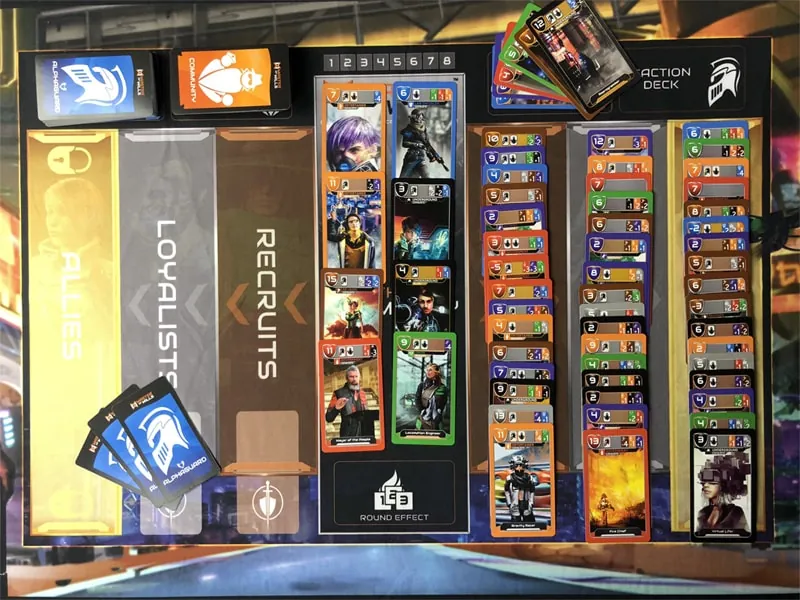
The board and cards are setup in the same way as the standard game. Use a shared 20-card deck. Each player draws 2 Faction cards to begin (not 3).
Teams decide who leads in Round 1 and who finishes in Round 8. It’s a critical decision and you are allowed to see your Faction cards before choosing.
Round 1: Player 1 (A) then Player 1 (B). Rounds 2-7 are played in a back-to-back format (A: 2/4/6, B: 3/5/7).
Players may use individual faction decks for mixed synergy. If a card targets an opponent's hand, you must choose 1 of the 2 players’ hands first.
To achieve more points than the opponent side of the board after 8 turns of play.
Mowitaire is an awesome way to play solo, practice your combos and most importantly is also a super catchy name! The game rules below provide you the basic on setup and game play but we encourage you to up the level of challenge if you find yourself winning it often.
Build a Standard faction deck (hint: build one that is not only entirely offensive but also there is not really a need to mess with opponent Faction plays) consisting of 2 Legendary, 5 Epics, 5 Neutrals, and 8 to 18 Actions.
Shuffle the Community deck and randomly deal:
Then deal 6 cards into the Afterlife and 8 cards into the Neutral Community area.
You now have 8 turns to achieve a higher score than what the “opponent” has at the end of the game. Use movements and Faction plays to take points from the "opponent" while adding points to your side.
Anytime a card says opponent may choose a card, randomly draw from what they would choose from. (e.g., Steel Moonfall: shuffle the neutral area and randomly draw 1 card into “opponent’s” Recruit row).
Click here to see how the board should look.This is a cooperative play where you and a partner will attempt to push points to BOTH sides of the board in order to beat a pre-defined score for each Round. If you do not achieve the minimal points on BOTH sides of the board, you lose. This game variant is super fun but will require a calculator, or if you want pen and paper, to keep track of scores as you move forward throughout the game.
Get a calculator, or if you want pen and paper. Shuffle Community deck and draw 2 cards to see who will go first (place in Afterlife). Deal 4 additional cards to Afterlife, 8 into the neutral area. Each player builds a standard deck (Hint: use cards that pull from neutral area or Community deck and give to both of you).
Each round, you and your partner must move the minimum number of points to both sides. For example, if Round 1 minimum is 20 points, you will need 20 on each side (40 total) to pass the Round.
Adjust the points prior to the game to change difficulty. Using +5/-5 Lasting Effects can make passing Rounds easier; track these turn-by-turn. Choosing not to use them increases difficulty significantly.
This variant plays almost identically to the standard 1 vs 1 game. The objective is to beat 2 opponent’s rather than just 1.
You will either need a second game board or you may use a handmade third row going down from the Round Effects area of the main game board. It’s simply adding a third Recruits, Loyalists, and Allies rows.
Set the board up as normal, build a standard deck (2 legendaries, 5 epics, 5 neutrals, min of 8 actions), and all 3 players draw to see who goes first. The player who draws the high card can choose to go first or pass to the next player in clockwise order. That player then can either go first or pass to the last player who then must go first. For the rest of the game that is the turn order.
There are now 3 turns per Round. When you choose a Starting card with negative movements, you may choose to move the card towards either opponent’s rows. This is the main difference in game play.
You must balance the points for both opponent’s being careful not to give one opponent too many points. If a card has a penalty for its use then any and all players affected by the play will gain from said penalty. For example, if you play The Loyal Gentlemen you could move 1 Recruit from each player but both players would then get 1 neutral area card to their Recruits; or move 2 from only one opponent and then only that player gets 1 neutral area card.